
How to Write a Technical RFP for Software Projects (with Practical Template)
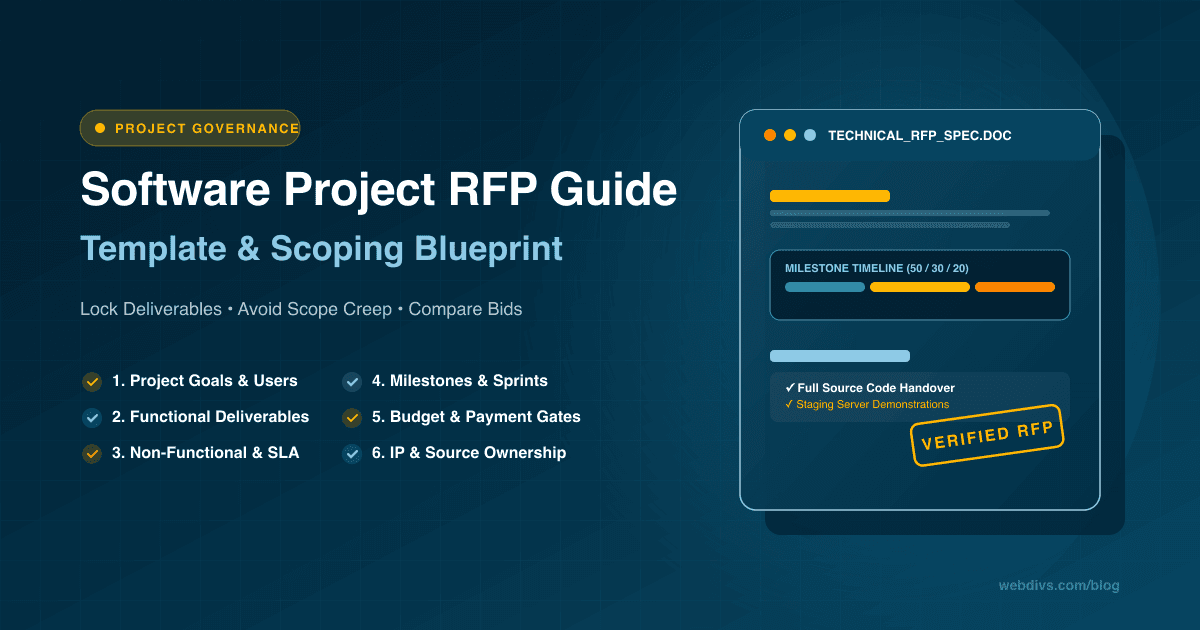
Direct Answer: A technical Request for Proposal (RFP) is the governing engineering document that defines software scope, functional deliverables, security benchmarks, and milestone-based payment triggers. Writing an authoritative RFP before soliciting agency bids prevents scope creep and ensures vendors bid against uniform, binding criteria.
Why 60% of Software Projects Suffer Scope Creep
The predominant cause of software development failure is underspecified requirements. Vague prompts like 'build an Uber clone' inevitably yield bids ranging by an order of magnitude, making objective vendor evaluation impossible.
A rigorous technical RFP levels the playing field, establishes mutual accountability, and anchors project delivery within deterministic budgets and timelines.
The 7 Pillars of an Authoritative Software RFP
- 1. Executive Summary & Business Objectives: Clear business rationale, commercial pain points, and measurable ROI targets.
- 2. User Personas & Workflows: Segmented roles across end users, administrative staff, and operations managers.
- 3. Functional Requirements: Discrete feature inventory with clear acceptance criteria.
- 4. Non-Functional Criteria: SLA uptime, latency tolerances, Core Web Vitals targets, and accessibility benchmarks.
- 5. Third-Party Integrations: Payment gateways, shipping APIs, ERP synchronization, and SMS providers.
- 6. Milestone Schedule & Payment Gates: Phased deliverables tied to verifiable demo acceptance.
- 7. Intellectual Property & Handover: Full unencumbered source code transfer and mandatory warranty coverage.
Vendor Proposal Evaluation Framework
Evaluate competing software agency proposals using a structured scoring rubric:
- Demonstrated Track Record: Verified live deployments with comparable scale and complexity.
- Engineering Rigor: Clear agile sprint governance, automated testing, and CI/CD pipelines.
- Ownership Sovereignty: Direct transfer of repository ownership and production server credentials.
Review Webdivs' documented delivery model on our Process and Delivery Framework or use our
interactive estimator on 2026 Project Pricing and Cost Calculations.
Frequently Asked Questions
Quick answers about this topic
An RFQ is used when exact specifications are already locked and only price bids are needed; an RFP requests technical architecture, delivery approach, and commercial pricing together.
Quality supersedes volume. For small to mid-market projects, 5–10 concise, structured pages are ideal, while enterprise systems may require 20–30 pages.
Execute a binding Non-Disclosure Agreement (NDA) with prospective software houses prior to transmitting proprietary workflows or confidential business logic.
The safest standard is milestone-gated disbursements (e.g. 50% upon design lock, 30% upon staging demo approval, and 20% upon production cutover and handover).
Want this for your product?
Send a short note about your project. We will review it and explain the next useful step.
Contact Our Team