
Why Modern Enterprises Choose Next.js Over WordPress in 2026
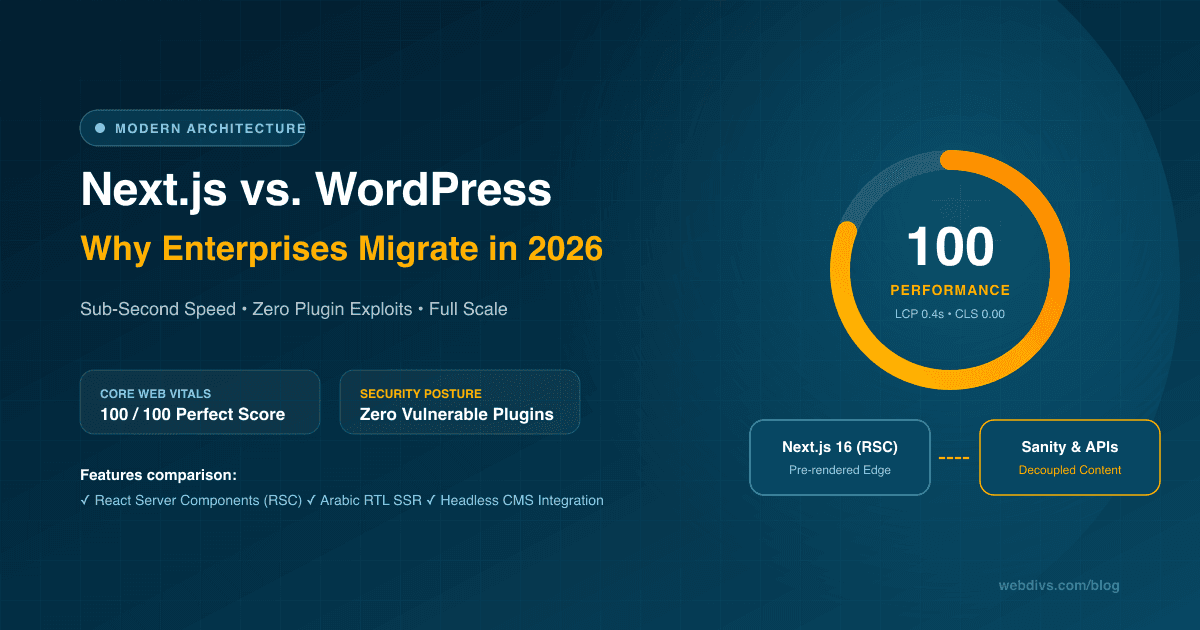
Direct Answer: In 2026, forward-thinking enterprises migrate from WordPress to Next.js to achieve sub-second Core Web Vitals, eliminate plugin-based attack vectors, and ensure scalable multilingual routing (Arabic/English). While WordPress remains suitable for basic content sites, enterprise workloads demand decoupled, zero-exploit architectures.
The Architectural Limits of Monolithic WordPress
For over two decades, WordPress served as the de facto web CMS. However, as Google's page experience signals became strict ranking prerequisites, the performance penalties of monolithic PHP stacks became prohibitive.
Enterprise WordPress sites routinely rely on 30+ plugins for multilingual routing, caching, and payment handling. This architectural bloat creates brittle dependencies where updating a single plugin risks cascading site failures or severe zero-day vulnerabilities.
Why Next.js with React Server Components Wins in 2026
- Zero-JS Server Components: Next.js renders complex UI on the edge or server, streaming minimal HTML to client devices and virtually eliminating client-side JavaScript execution lag.
- Hardened Security: Without dynamic PHP plugins running in the web root, common attacks like SQL injection and unauthorized file uploads are eliminated by design.
- Native BiDi Routing: Clean locale routing without heavy database translation plugins that degrade TTFB.
- Edge Scalability: Global CDN distribution and edge runtime compatibility mean handling flash traffic without server crashes.
Performance & Maintenance Cost Comparison
Benchmarking data from enterprise deployments in Cairo and the GCC illustrates the operational divergence:
- Largest Contentful Paint (LCP): Sub-800ms in modern Next.js deployments vs 3.2s+ in typical corporate WordPress setups.
- Cumulative Layout Shift (CLS): 0.00 deterministic stability with Next.js Image optimization.
- Year-over-Year Maintenance: 60% reduction in break-fix overhead caused by plugin incompatibilities.
Explore our technical deep dive on WordPress vs Custom Development in Egypt or inspect our enterprise-grade
capabilities in Full-Stack Web Development Services.
Frequently Asked Questions
Quick answers about this topic
Not at all. Next.js pairs with modern Headless CMS platforms like Sanity, providing a faster, cleaner, and more intuitive editorial interface than traditional WordPress wp-admin.
When executed with proper 301 redirect mapping and metadata preservation, site speed improvements typically boost rankings rather than harming them.
WordPress remains viable for small personal blogs and simple marketing sites with limited traffic that do not require custom APIs or enterprise security.
Next.js handles bilingual routing natively via App Router subpaths, applying automated dir='rtl' and dir='ltr' switching without bloated plugin tables.
Want this for your product?
Send a short note about your project. We will review it and explain the next useful step.
Contact Our Team